Heat pump and solar panels in the Netherlands: maximise savings
Heat pump and solar panels in the Netherlands: maximise savings
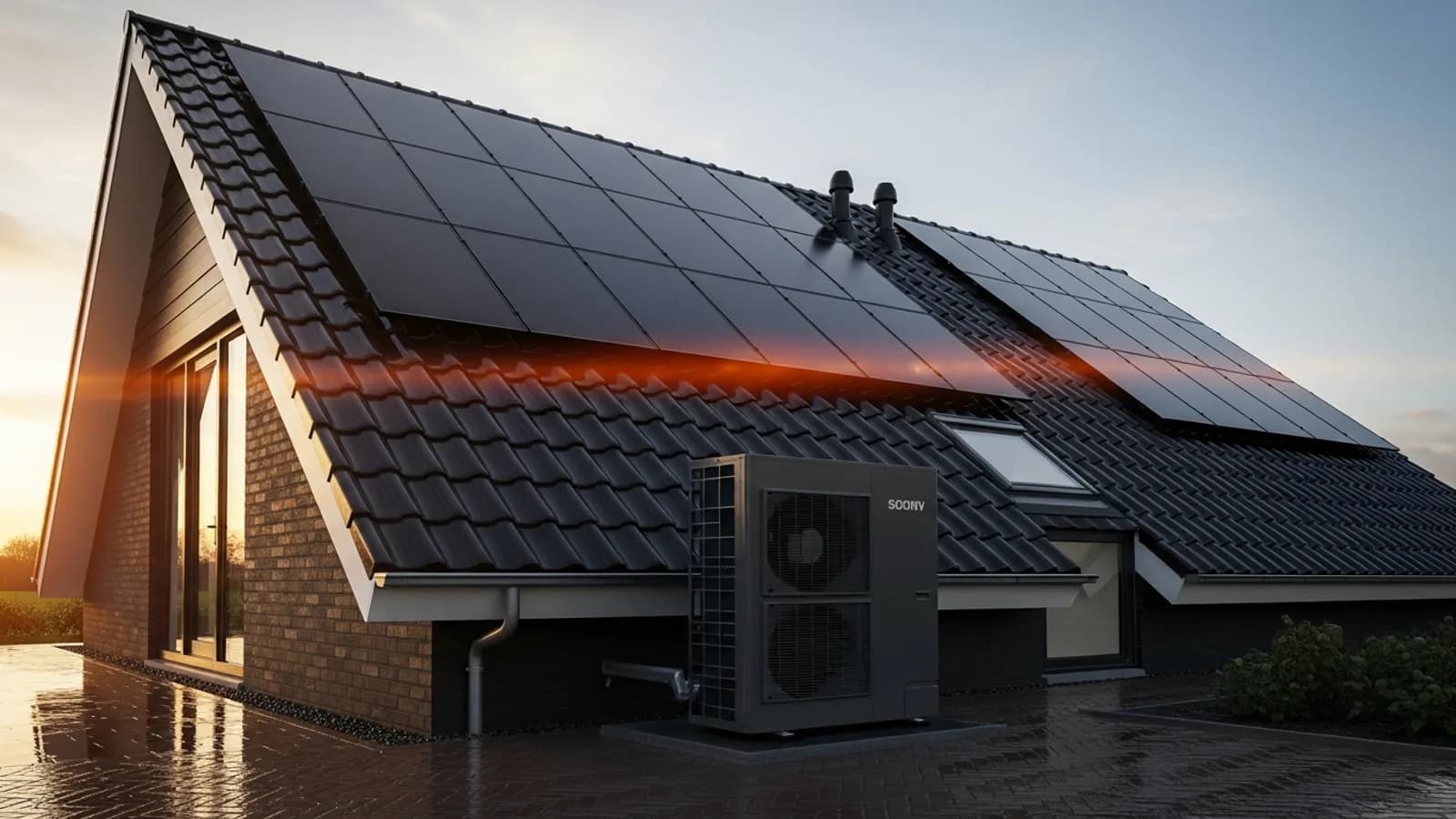
A heat pump runs on electricity. Solar panels generate electricity. Combine them and you heat your home with energy from your own roof. The logic is straightforward. The execution has nuances that make the difference between a profitable investment and a disappointment.
Your heat pump works hardest in winter. Your solar panels produce the most in summer. That mismatch is the central challenge. And in the Netherlands, the salderingsregeling (net metering scheme) still bridges the gap in 2026 -- but that is changing.
Why this combination works so well financially
Without solar panels, an all-electric heat pump costs you 840-1,260 euros in additional electricity per year (at 3,000-4,500 kWh extra consumption and 0.28 euros/kWh). With solar panels, you generate much of that electricity yourself. That reduces not just your costs but also your payback period.
Quick example:
An all-electric heat pump consuming 3,500 kWh per year. Twelve south-facing solar panels generating 4,200 kWh per year. In theory, you produce more than enough to power the heat pump. In practice, the timing does not always align -- but thanks to net metering, that does not matter much in 2026.
Those 4,200 kWh compensate not only the heat pump consumption but also part of your regular household electricity use (average 2,500-3,500 kWh). Combined, the pair saves you 1,800-2,200 euros per year on your energy bill.
For a hybrid heat pump, the picture is similar but more modest. The heat pump uses approximately 1,000-1,500 kWh extra. Eight solar panels cover that easily.
How many solar panels do you need?
It depends on three things: the type of heat pump, your household electricity consumption, and your roof orientation.
| Situation | Extra electricity from heat pump | Recommended panels (380 Wp) | Annual output |
|---|---|---|---|
| Hybrid heat pump | 1,000 - 1,500 kWh | 3 - 4 panels | 1,150 - 1,520 kWh |
| Air-to-water heat pump | 3,000 - 4,500 kWh | 8 - 12 panels | 3,040 - 4,560 kWh |
| Ground source heat pump | 2,500 - 3,500 kWh | 7 - 10 panels | 2,660 - 3,800 kWh |
This is on top of the panels you already need for regular household consumption. A typical household going all-electric needs 16-20 solar panels to cover total electricity use. That fits on most Dutch terraced house roofs, though it gets tight.
Tip: South-facing roofs produce the most (approximately 950 kWh per kWp per year in the Netherlands). East- and west-facing roofs yield 15-20% less but produce more evenly throughout the day, which is actually better for direct self-consumption.
Net metering: what is changing?
Until now, electricity you generate during the day but do not immediately use gets fed back to the grid. Your energy supplier offsets that 1-to-1 against consumption at other times. This is called salderen (net metering).
But the salderingsregeling is being phased out. Here is the current status:
- 2026: You can still net meter 100%. No change from 2025.
- 2027-2030: Gradual phase-out. The percentage you can net drops stepwise.
- After 2030: Full abolition. You receive only a feed-in tariff (approximately 0.05-0.08 euros/kWh) instead of the full consumer price.
What does this mean for the heat pump + solar combination?
Short-term (2026-2027): minimal impact. You net meter as normal.
Medium-term (2028-2031): direct self-consumption becomes important. You want to use as much electricity as possible at the moment your panels are generating. This is where it gets interesting -- because you can schedule your heat pump intelligently.
Smart scheduling: making the combination work harder
Modern heat pumps and energy management systems can activate the heat pump when the solar panels are producing. This maximises self-consumption and works like this:
During the day (panels producing): the heat pump heats the house and hot water tank more than needed. You are effectively storing heat as energy.
Evening and night (no solar production): the heat pump is off or runs at low capacity. The house slowly cools, but the thermal buffer you built up maintains comfort.
Brands like Daikin (Residential Controller), NIBE (myUplink), and Vaillant (sensoAPP) offer this functionality as standard. Samsung does it through the SmartThings app.
What about a home battery? It makes the picture even more attractive -- you store solar electricity in the battery and use it for the heat pump at night. But battery storage is still expensive in 2026: 5,000-10,000 euros for a useful capacity of 5-10 kWh. The payback on the battery alone is long. Whether it makes financial sense depends on your specific situation and how quickly net metering disappears.
The complete financial picture
Let us calculate the total for a terraced house with an all-electric heat pump and 14 solar panels.
Investment:
- Air-to-water heat pump including installation: 9,500 euros
- 14 solar panels (380 Wp, including installation): 6,500 euros
- ISDE subsidy for heat pump: -3,800 euros
- Total net investment: 12,200 euros
Annual savings:
- Gas savings (1,500 m3 x 1.40 euros): 2,100 euros
- Solar electricity generated (5,320 kWh x 0.28 euros): 1,490 euros
- Additional electricity for heat pump (3,500 kWh x 0.28 euros): -980 euros
- Net annual savings: 2,610 euros
Payback period: approximately 4.7 years
Compare that with a heat pump alone (payback approximately 5.4 years) or solar panels alone (payback approximately 4.4 years). The combination delivers the highest total return.
What to install first: panels or heat pump?
If you cannot afford both at once, install solar panels first. Three reasons.
First, solar panels are cheaper and pay for themselves faster. The cash flow they generate (lower electricity bills) can fund the heat pump investment a year later.
Second, with panels already on your roof, you benefit from free electricity for the heat pump from day one of installation.
Third, net metering still applies fully now. The sooner your panels are up, the more years of 100% net metering you enjoy.
Insulation, by the way, always comes first. Insulate, then solar panels, then heat pump. In that order, you extract maximum return from each investment.
Practical considerations
Electrical panel and connection. A heat pump plus solar panels together may require a more robust electrical connection. The standard 1x25 amp connection in many Dutch homes can become insufficient. Upgrading to 3x25 amp costs 300-600 euros and must be requested from your grid operator (Liander, Stedin, Enexis). Lead time: 4-8 weeks.
Inverter and panels. Use micro-inverters or a string inverter with MPP tracking so shading on one panel does not affect the whole array. With 14+ panels on a complex roof (dormer, chimney), an optimiser system is recommended.
Roof structure. Fourteen solar panels weigh approximately 250-300 kilograms. Most roofs handle this easily, but for homes built before 1970, a roof survey is wise.
Battery-ready installation. In 2026, a home battery is hard to justify financially for most households. But as net metering phases out after 2027, that changes quickly. Consider making your installation "battery-ready" now -- it saves costs later.
Key takeaways
- The heat pump + solar panel combination delivers the highest savings: up to 2,600 euros per year with an all-electric system.
- A hybrid heat pump needs 3-4 extra solar panels; an all-electric system needs 8-12.
- Net metering applies fully in 2026 but will be phased out after 2027.
- Smart scheduling of the heat pump based on solar production maximises self-consumption.
- Invest in this order: insulation first, then solar panels, then heat pump.
Frequently asked questions
How many solar panels do I need for a heat pump?
For a hybrid: 3-4 additional panels (380 Wp). For an all-electric air-to-water system: 8-12 additional panels. This is on top of panels for household consumption. In total, an all-electric household typically needs 16-20 panels to cover everything.
Can a heat pump run directly on solar panels?
Not directly. The heat pump runs on mains power (230V AC) while solar panels produce direct current (DC). The inverter converts solar power to alternating current that reaches the heat pump through your home's electrical installation. You always need a grid connection -- unless you have an off-grid setup with battery storage, which is exceptional in the Netherlands.
Should I buy a home battery with my heat pump and solar panels?
In 2026, that is not yet cost-effective for most households. A 5-10 kWh battery costs 5,000-10,000 euros and saves approximately 200-400 euros per year in non-metered electricity. That is a 15-25 year payback. Wait for battery prices to drop or for net metering to actually be phased out.
What does the heat pump plus solar panels combination save financially?
With an all-electric heat pump and 14 solar panels, expect approximately 2,600 euros per year in savings. The total investment (after ISDE subsidy) is approximately 12,200 euros. Payback: under 5 years. After that, it is pure savings on your energy bill.
Do solar panels produce enough in winter when the heat pump needs them most?
Yes, but less. In December and January, solar panels produce roughly 30-40% of their summer peak. On an average winter day, 14 panels generate about 5-8 kWh while your heat pump needs 15-25 kWh. The shortfall comes from the grid. In summer, you produce a surplus that you earn back through net metering.
Do I need a heavier electrical connection?
Probably. A heat pump draws 2,000-4,000 watts at peak load, and combined with cooking, EV charging, and household appliances, your 1x25A connection may not suffice. Upgrading to 3x25A costs approximately 300-600 euros and is handled by your grid operator.
Ready for the next step?
An installer experienced with the heat pump and solar panel combination can calculate the optimal setup for your home. Many installers in our network install both systems.
Related articles
Frequently asked questions
How many solar panels do I need for a heat pump?
For a hybrid: 3-4 additional panels (380 Wp). For an all-electric air-to-water system: 8-12 additional panels. This is on top of panels for household consumption. In total, an all-electric household typically needs 16-20 panels to cover everything.
Can a heat pump run directly on solar panels?
Not directly. The heat pump runs on mains power (230V AC) while solar panels produce direct current (DC). The inverter converts solar power to alternating current that reaches the heat pump through your home's electrical installation. You always need a grid connection -- unless you have an off-grid setup with battery storage, which is exceptional in the Netherlands.
Should I buy a home battery with my heat pump and solar panels?
In 2026, that is not yet cost-effective for most households. A 5-10 kWh battery costs 5,000-10,000 euros and saves approximately 200-400 euros per year in non-metered electricity. That is a 15-25 year payback. Wait for battery prices to drop or for net metering to actually be phased out.
What does the heat pump plus solar panels combination save financially?
With an all-electric heat pump and 14 solar panels, expect approximately 2,600 euros per year in savings. The total investment (after ISDE subsidy) is approximately 12,200 euros. Payback: under 5 years. After that, it is pure savings on your energy bill.
Do solar panels produce enough in winter when the heat pump needs them most?
Yes, but less. In December and January, solar panels produce roughly 30-40% of their summer peak. On an average winter day, 14 panels generate about 5-8 kWh while your heat pump needs 15-25 kWh. The shortfall comes from the grid. In summer, you produce a surplus that you earn back through net metering.
Do I need a heavier electrical connection?
Probably. A heat pump draws 2,000-4,000 watts at peak load, and combined with cooking, EV charging, and household appliances, your 1x25A connection may not suffice. Upgrading to 3x25A costs approximately 300-600 euros and is handled by your grid operator. ## Ready for the next step? An installer experienced with the heat pump and solar panel combination can calculate the optimal setup for your home. Many installers in our network install both systems. [Find an installer near you][link:/provincie/gelderland] ## Related articles - [What does a heat pump cost in the Netherlands in 2026?][link:/gids/heat-pump-costs] - [Heat pump subsidy 2026: ISDE application guide][link:/gids/heat-pump-subsidy] - [Hybrid vs all-electric heat pump: how to choose][link:/gids/hybrid-vs-all-electric]